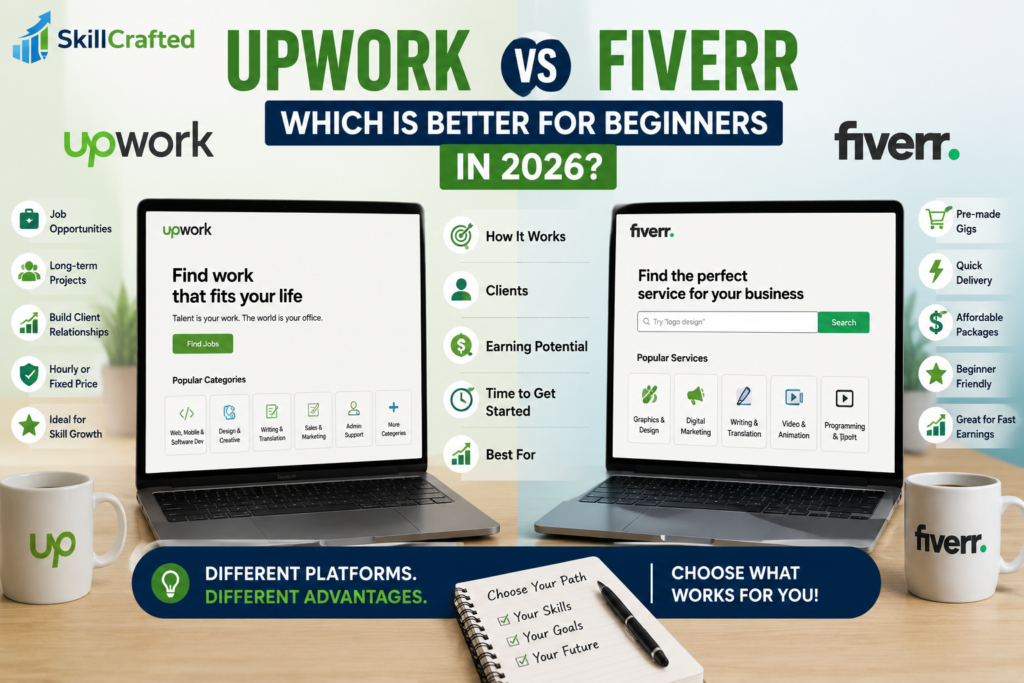
If you’re just starting freelancing, there’s a good chance you’ve come across two platforms almost immediately: Upwork and Fiverr.
And naturally, the question follows: Which one should you start with?
Both platforms are popular. Both have thousands of clients. And both can help you make money online.
But they work very differently: and choosing the right one as a beginner can save you a lot of time, frustration, and trial-and-error.
In this guide, we’ll break down Upwork vs Fiverr for beginners, in a simple and realistic way, so you can decide which platform fits you best.
Understanding the Core Difference
Before comparing features, it’s important to understand one key difference.
- On Upwork, you apply for jobs.
- On Fiverr, clients find you.
That alone changes the entire experience.
Upwork is more proactive. You search for jobs, send proposals, and try to win projects.
Fiverr is more passive. You create a service listing (called a gig), and clients browse and choose whether to hire you.
Neither approach is better universally, but one may suit you better depending on your personality and starting point.
Getting Started: Which Is Easier?
For most beginners, Fiverr feels easier at the beginning.
You don’t need to write proposals or compete directly for jobs. You simply set up your profile, create your services, and wait for clients to discover you.
However, “easier” doesn’t always mean faster results.
Fiverr can take time to gain visibility, especially when your profile is new and has no reviews.
Upwork, on the other hand, requires more effort upfront. You need to search for jobs and send proposals.
At first, this can feel uncomfortable, especially if you’ve never pitched yourself before.
But the advantage is that you can actively go after opportunities instead of waiting.
How Fast Can You Get Your First Client?
This is where many beginners struggle, and the answer depends on how you approach each platform.
On Upwork, your chances depend on how well you apply.
If you write clear, simple proposals and apply consistently, you can get your first client relatively quickly — sometimes within days or weeks.
On Fiverr, it’s less predictable.
You might get your first order quickly if your gig is well-optimized, but in many cases, it takes time for the platform to start showing your profile to potential buyers.
So if your goal is speed and you’re willing to put in effort, Upwork often gives you more control.
Competition: Where Is It Easier to Stand Out?
Both platforms are competitive: there’s no way around that, however the type of competition is different.
- On Fiverr, you’re competing based on how your gig looks. Titles, descriptions, pricing, and visuals all play a role.
New sellers often struggle because there are already established freelancers with reviews.
- On Upwork, competition happens through proposals.
You’re not competing on a public listing: you’re competing in the client’s inbox.
This can actually be an advantage.
Even as a beginner, a well-written, thoughtful proposal can stand out more than a perfect-looking profile.
Pricing and Earning Potential
Pricing works very differently on each platform.
On Fiverr, pricing is structured around your gigs. Many beginners start with lower prices to attract their first clients.
This can make it feel like a race to the bottom if you’re not careful.
On Upwork, pricing is more flexible.
You can:
- Set your hourly rate
- Bid based on the project
- Adjust your pricing depending on the job
This gives you more control over how you position yourself.
In the long run, both platforms allow you to increase your rates — but Upwork often makes it easier to move toward higher-paying projects.
Learning Curve for Beginners
If you’re completely new, Fiverr may feel more intuitive.
The process is simple: create a gig, describe your service, and publish it.
Upwork has a slightly steeper learning curve.
You need to:
- Understand how to search for jobs
- Learn how to write proposals
- Decide how to price your work
At first, this can feel like a lot.
But it also teaches you valuable skills early, especially communication and positioning, which are essential in freelancing.
Real-Life Scenario: What It Actually Looks Like
To make this more practical, let’s look at how a beginner might experience both platforms in the first few weeks.
If you start on Upwork, your first days will likely involve setting up your profile and sending proposals. At first, it may feel like you’re putting in effort without getting responses. That’s normal.
But something important happens during this phase — you start improving. Your proposals get clearer, your understanding of client needs improves, and you begin to notice patterns in job postings.
Eventually, one client responds. Then another. And suddenly, you’re not guessing anymore — you’re working.
With Fiverr, the experience is different.
You spend time creating your gig, choosing a title, writing descriptions, and maybe even designing visuals. Then you publish it… and wait.
This waiting period can feel frustrating, especially if nothing happens for a few days or even weeks.
But once your first order comes in, things can start to snowball. A good review leads to better visibility, and better visibility leads to more orders.
Both paths work, they just require different types of patience.
Which Platform Fits Your Personality?
This is something many guides don’t talk about, but it matters more than you think.
If you are someone who:
- Likes taking initiative
- Doesn’t mind reaching out
- Learns by doing
Then Upwork will likely feel more natural over time.
If you prefer:
- Setting things up once
- Letting opportunities come to you
- Avoiding direct pitching
Then Fiverr may feel more comfortable.
There is no “right” personality type — just different approaches.
A Common Beginner Mistake
Many beginners jump between platforms too quickly.
They try Fiverr for a few days, see no results, switch to Upwork, get discouraged, and then move on again.
The problem isn’t the platform — it’s the lack of consistency.
Both Upwork and Fiverr require time to build traction. Whether it’s learning how to write better proposals or improving your gig visibility, results come from staying consistent long enough to improve.
If you commit to one platform for even a few weeks with focused effort, you’ll start seeing a difference.
Can You Really Make Money on Both?
Yes and this is important to clarify.
There’s no shortage of success stories on either platform. Many freelancers build full-time income using just one of them.
But at the beginning, your focus shouldn’t be on “how much others are making.”
It should be on:
- Getting your first client
- Delivering good work
- Building confidence
The income grows naturally from there.
When Should You Use Both Platforms?
Once you start gaining some experience, using both platforms can actually be a smart move.
For example:
- You use Upwork to actively find clients
- You keep Fiverr as a passive channel for incoming work
This creates balance.
Instead of relying on one source, you create multiple ways to attract opportunities: which is exactly how freelancers build stability over time.
Closing Thought
At the end of the day, platforms don’t build freelance careers — people do.
The platform you choose matters far less than the consistency you bring to it.
Start somewhere. Stay consistent. Improve as you go.
That’s what actually works.