If you’re looking to start earning online, one of the first questions you’ll likely face is this:
Should I start freelancing or look for a remote job?
At first glance, they may seem similar. Both allow you to work online, often from home, and both can give you flexibility.
But in reality, they are very different paths.
For beginners, choosing the right one can make a big difference in how quickly you start earning, how stable your income is, and what kind of lifestyle you build over time.
In this guide, we’ll break down freelancing vs remote jobs for beginners, so you can decide which option fits you best.
What Is Freelancing?
Freelancing means offering a service to clients on a project basis.
Instead of working for one employer, you work with different clients who hire you for specific tasks.
For example, you may be hired to:
- Write blog articles
- Manage social media
- Design visuals
- Handle admin work
As a freelancer, you’re essentially running your own service-based business.
You choose:
- Who you work with
- What you charge
- When you work
This flexibility is one of the biggest reasons people are attracted to freelancing.
What Is a Remote Job?
A remote job is more similar to a traditional job: the difference is that you work online instead of in an office.
You usually work for one company and have a defined role, such as:
- Remote customer support
- Marketing assistant
- Project coordinator
- Content writer
In most cases, you’ll have:
- Fixed responsibilities
- A monthly salary
- Working hours or deadlines set by the company
For many beginners, this feels more structured and secure.
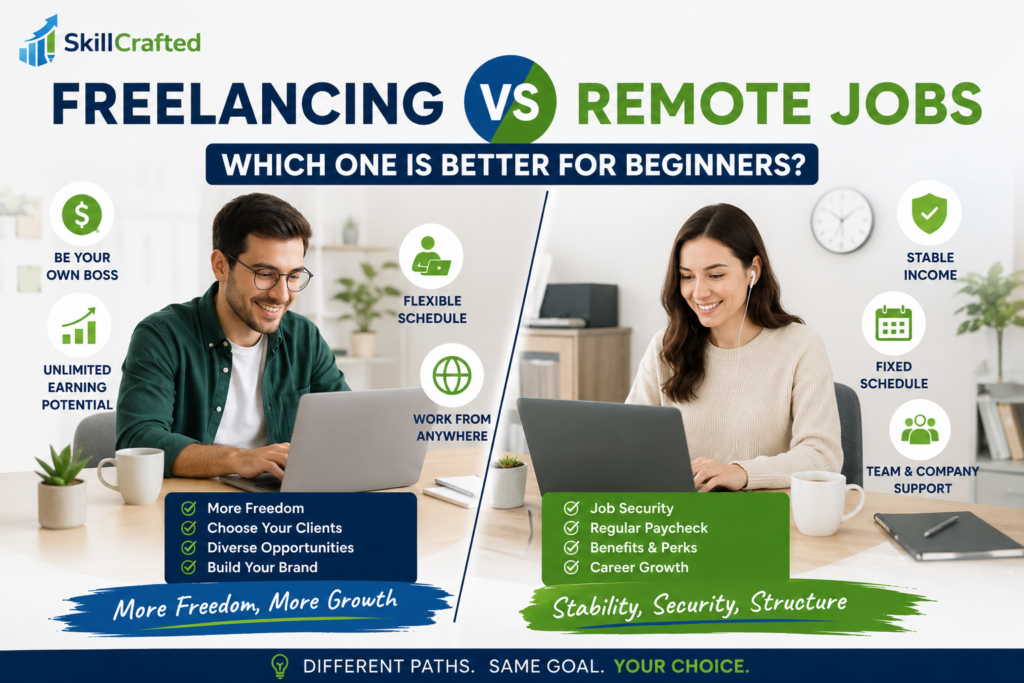
Income: Which One Is Better?
This is one of the biggest deciding factors.
Remote jobs usually offer more stability.
You know what you’ll earn every month, which makes budgeting easier.
Freelancing, on the other hand, can be less predictable in the beginning.
Some months may be strong, while others may be slower.
However, freelancing often has higher income potential over time because you control your pricing and can work with multiple clients.
For beginners who value stability, remote jobs may feel safer.
For those who want growth potential, freelancing often wins in the long run.
Flexibility and Freedom
When it comes to flexibility, freelancing usually offers more freedom.
You can decide:
- Your working hours
- Which projects to accept
- When to take breaks
This makes it ideal for people who want a flexible lifestyle.
Remote jobs can also be flexible, especially if they’re asynchronous, but many still come with fixed schedules and expectations.
So if flexibility is your top priority, freelancing may be the better option.
Learning Curve for Beginners
For absolute beginners, remote jobs can sometimes feel easier.
The reason is simple: structure.
You often receive:
- Training
- Clear tasks
- Team support
Freelancing requires more independence.
You need to:
- Find clients
- Pitch your services
- Manage deadlines
- Handle communication
This can feel overwhelming at first.
That said, freelancing also teaches valuable skills faster because you are directly responsible for the full process.
Which One Helps You Build Skills Faster?
Freelancing usually accelerates skill development.
Because you work with different clients and projects, you’re constantly adapting and learning.
You improve not only your technical skill but also:
- Communication
- Client management
- Pricing
- Time management
Remote jobs often allow you to go deeper into one specific role, which is also valuable.
The best option depends on whether you want breadth or structure.
Career Growth Potential
This is where the paths begin to differ significantly.
A remote job can lead to promotions, salary increases, and long-term employment opportunities.
Freelancing can evolve into:
- A full-time business
- An agency
- A personal brand
- Multiple income streams
If your long-term vision includes building something of your own, freelancing may align better.
Which One Is Less Stressful?
This depends on your personality.
If uncertainty stresses you out, freelancing may feel challenging in the beginning.
You’ll need to deal with inconsistent client flow and self-management.
If structure and clear expectations make you feel more comfortable, a remote job may be less stressful.
However, some people find remote jobs mentally exhausting because of fixed schedules and company expectations.
There is no universal answer: it comes down to what kind of pressure you handle better.
So Which One Is Better for Beginners?
If you need stable income and structure:
Remote jobs may be the better starting point
If you want flexibility, independence, and higher long-term potential:
Freelancing is often the better path
For many beginners, a smart approach is to start with one and gradually explore the other.
Some people begin with a remote job for stability and freelance on the side.
This can be a very balanced way to start.
Final Thoughts & Conclusion
There is no single “best” choice.
The better option is the one that fits your current goals, lifestyle, and personality.
Both freelancing and remote jobs can help you build income online.
The key is to choose one path, commit to it, and take consistent action.
Ask yourself:
- Do I value stability right now?
- Do I want flexibility and growth?
- What feels more realistic for me at this stage?
Then continue exploring our guides to take the next step in your online income journey.
The most important thing is not choosing perfectly — it’s starting.